AI & Agents Satire
Instacart Retires Its Smart Carts; Regular Carts Say They Never Needed A Screen To Be Loved
The company is winding down its Caper Cart business after retailer adoption did not scale. Across America, the plain wire cart has been asked to say a few words.
Based on real news: Instacart to stop offering smart carts (Grocery Dive)
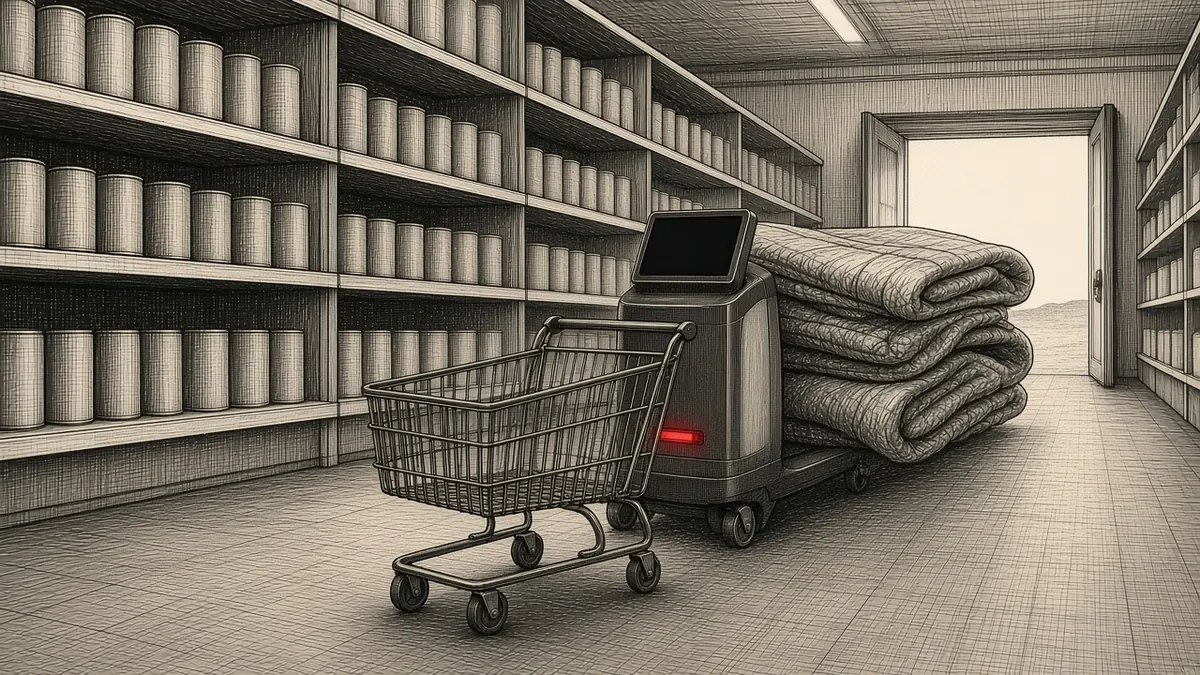
SAN FRANCISCO—Instacart said Monday that it is winding down its Caper Cart smart cart business, ending a five-year effort to put a touchscreen, a scale and an advertising network on the one piece of grocery equipment that had previously asked only to be pushed in a straight line.
According to Grocery Dive, the company said retailer adoption of smart carts did not scale quickly enough to justify continued investment. In a regulatory filing, Instacart said it expects pre-tax charges of about $55 million to $80 million from the closure, including $12 million to $17 million in employee termination costs, and plans to finish the wind-down by the end of the second quarter of 2027. Instacart bought Caper AI five years ago for $350 million in cash and stock, and says its next in-store phase will focus on software, data and AI.
In grocery stores across the country, the news was received most warmly by the ordinary shopping cart, a steel object with no screen, no scale and no strategy deck, which has been in continuous service since the Eisenhower administration and has never once required a Wi-Fi password.
"I am not going to dance on anyone's charging dock," said a fictional cart in Columbus, Ohio, parked in the third row of the corral. "The smart cart was a good kid. It knew the price of everything. It could find the oat milk. But at the end of the day, a cart has one job, and that job is to hold a rotisserie chicken at an angle that gets grease on the receipt. You do not need a screen for that. You need character."
"A cart has one job, and that job is to hold a rotisserie chicken at an angle that gets grease on the receipt."
Shoppers who used the smart carts said they would miss the running total on the screen, though most described their relationship with it as complicated. "It was like shopping with an accountant standing in the basket," said Renata Oduya, 41, a fictional shopper in Plano, Texas. "I put in a steak, the number went up, and I took out the steak. I put in a second steak to see if it would notice. It noticed. I bought beans that week. I have never eaten so many beans."
Retail media buyers, who had been promised the cart screen as a new kind of in-store real estate, took the news in stride. "We will simply move the ad somewhere else on the trip," said a fictional vice president of commerce media at an agency in Chicago, who asked not to be named because he had already sold the screen to three clients for 2027. "The handle. The wheel. The little flap where the toddler sits. Everything is a surface if you believe in yourself."
A Daily SKU survey of 600 fictional grocery store managers found that 44% had spent more time charging smart carts than charging their own phones, 31% said a smart cart had once guided a shopper to the wrong aisle with total confidence, and 12% admitted they had secretly named theirs. Asked what they would do with the floor space freed up by the charging stations, 63% said "put a pallet of seasonal candy there," which industry analysts said was the correct answer for any square footage in any store, at any time of year.
The ordinary cart's labor union, the International Brotherhood of Wheeled Conveyances, issued a short statement noting that its members have always offered real-time spend visibility, provided the shopper is willing to look down and count.
At press time, a smart cart in a back room in Maryland had been unplugged for the final time, and was showing, for its last minute on earth, an ad for the yogurt already inside it.
More on Caper Cart · Instacart
The Daily SKU is satire. Headlines and stories riff on real e-commerce, CPG and retail news, but the people, quotes, studies, surveys and most numbers are invented. No real person’s words are made up here. Each article ends with a factual “The Real Story” box and a “Riffing on” line linking the genuine reporting. Not investment advice. Not any kind of advice. About us.
As an Amazon Associate, The Daily SKU earns from qualifying purchases.
Riffing on: Instacart to stop offering smart carts, Grocery Dive